
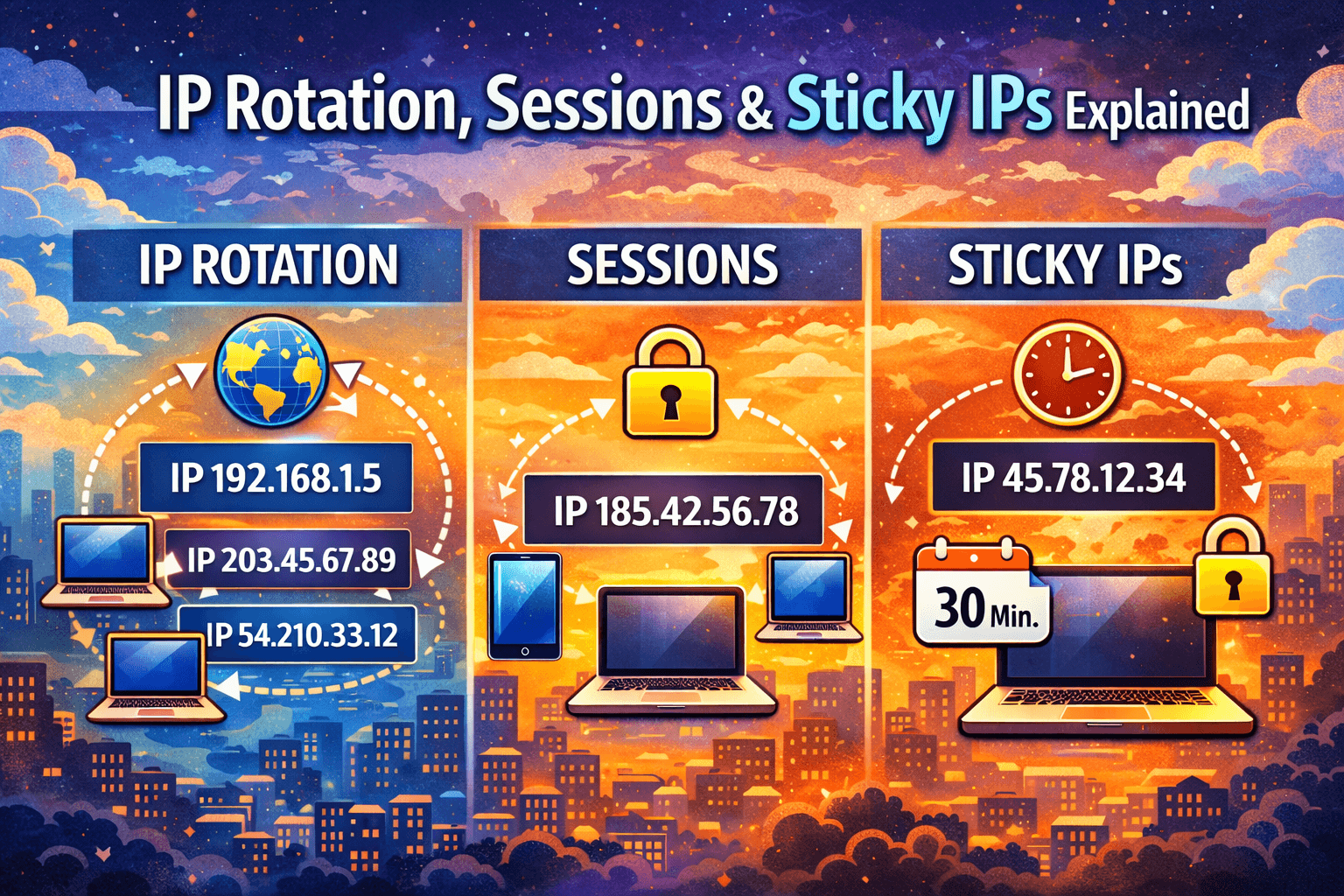
Common Proxy Terms: IP Rotation, Sessions, and Sticky IPs
Proxy services often use the same technical terms. IP rotation. Sessions. Sticky IPs.
At first glance, they seem straightforward. However, many explanations stop at surface-level definitions.
That lack of clarity causes real problems. When proxy behavior does not match the task, blocks increase, sessions break, and costs rise. Therefore, understanding these terms is not optional. It is essential.
This article explains how these proxy models work in practice. More importantly, it explains how websites actually respond to them.
How proxy identity really works
Every proxy request presents an IP address to a website. That part never changes.
What does change is how long that IP remains the same.
Because of this, proxy behavior is really about identity persistence.
Some proxies change IPs constantly. Others keep the same one for a while. Each approach creates a different footprint. As a result, websites react differently to each model.
Once you understand that, the terminology becomes much easier.
IP rotation: frequent identity changes
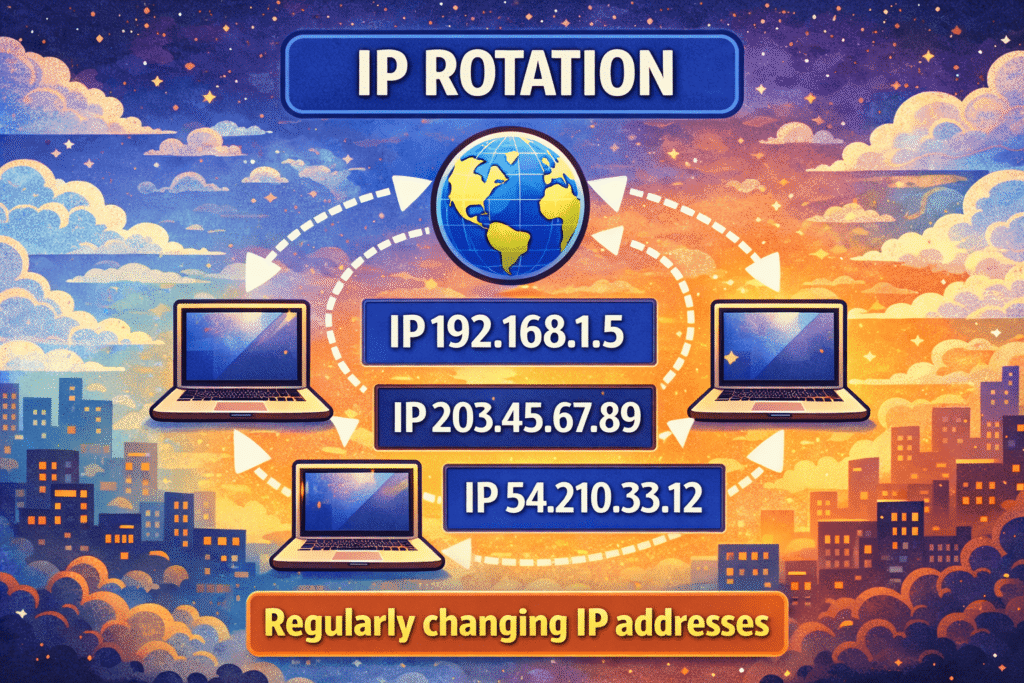
IP rotation means the proxy switches IPs often. In some setups, it happens on every request. In others, it happens after a short time window.
From the website’s point of view, the traffic comes from many different users. Therefore, no single IP builds a long history.
This works well when requests are independent. For example, fetching public pages or checking prices does not require continuity.
However, rotation also creates instability. Because identities change so quickly, behavior can look inconsistent. Locations shift. Connection patterns reset. In response, some detection systems flag the pattern instead of the IP.
So while rotation reduces per-IP risk, it also prevents trust from forming.
Sessions: intentional consistency

Sessions exist to solve that problem.
With a session, the proxy keeps the same IP for a group of related requests. Once the session ends, the IP rotates. Until then, identity remains stable.
As a result, websites see normal user behavior. Logins stay valid. Rate limits apply correctly. Navigation flows remain intact.
Sessions are especially important for authenticated actions. Without them, even clean IPs fail quickly.
In practice, most “real user” traffic relies on sessions. Even when users don’t realize it, session persistence is what makes things work.
Sticky IPs: time-based persistence
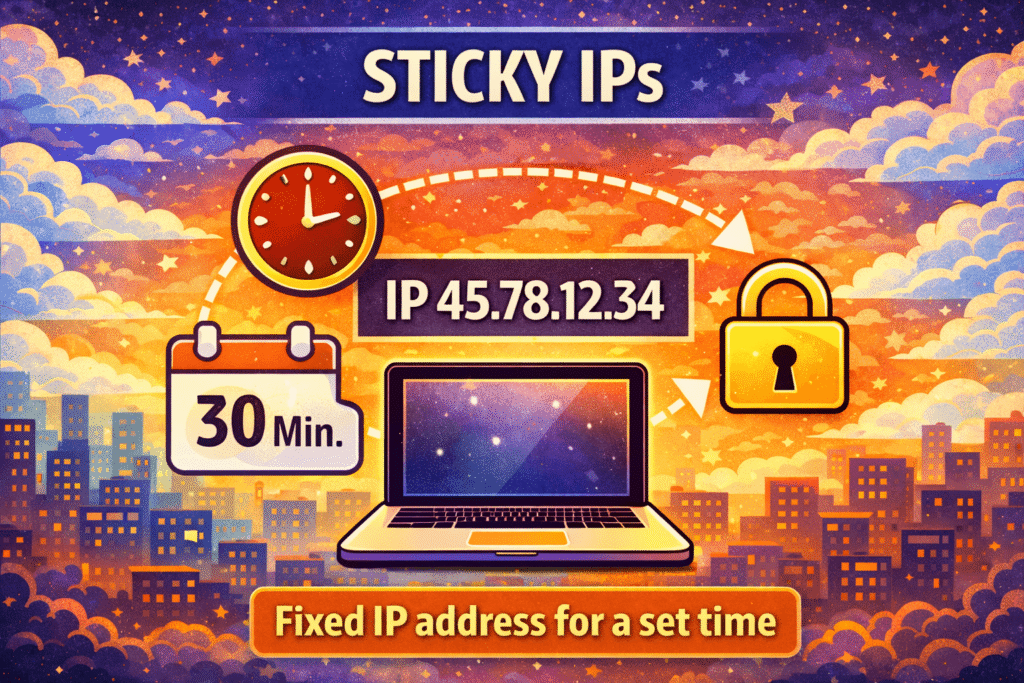
Sticky IPs add a time limit to session behavior.
The proxy assigns an IP and holds it for a fixed duration. Five minutes. Ten minutes. Sometimes longer. After that, rotation happens automatically.
Because of this, sticky IPs are easy to use. There is no session management. There are no IDs to track.
However, timing becomes critical. If the sticky window expires mid-task, continuity is lost. Likewise, if the IP is flagged early, the entire window is affected.
Sticky IPs provide consistency. But they limit control.
How these models behave in practice
Although the terms sound different, they overlap in real usage.
Rotation favors breadth. Sessions favor stability. Sticky IPs favor simplicity.
Problems occur when the proxy model does not match the task.
For example, checkout flows break under rotation because identity changes mid-process. Sessions work because the site sees one user. Sticky IPs work only if the timer is long enough.
Meanwhile, large-scale scraping behaves differently. Reusing one IP too long increases correlation. In that case, rotation performs better.
So the task defines the correct behavior, not the plan name.
Detection and trust implications
Websites do not judge IPs in isolation. Instead, they analyze behavior over time.
Fast rotation reduces exposure per IP. However, it increases behavioral noise.
Sessions allow trust to build naturally, assuming the IP itself is clean.
Sticky IPs fall somewhere in between, depending on timing.
Because of this, one stable IP acting normally is often safer than many IPs acting oddly.
That is why experienced operators usually prefer sessions over aggressive rotation.
Performance and reliability
Proxy behavior also affects performance.
Rotation forces new connections. As a result, latency increases and failures become more common.
Sessions and sticky IPs reuse connections. Therefore, they are more stable and predictable.
For simple requests, the difference may be small. For multi-step workflows, it is significant.
Cost considerations
Persistent IP usage costs more for providers. Because of this, session-based access is priced higher. Sticky durations are limited. Concurrent sessions are capped.
From the user’s side, misuse is the real expense. Using rotation when continuity is required wastes IPs. Using long stickiness when it is not needed increases blocks.
In practice, the cheapest option often performs the worst.
A practical comparison
Rotation works best when identity does not matter.
Sessions work best when identity must persist.
Sticky IPs work best when you want session behavior with minimal setup.
None of these models is universally superior.
Final verdict: focus on identity, not terminology
Effective proxy usage starts with a simple question:
How long should this traffic look like the same user?
Once that is clear, the terminology stops being confusing. Rotation, sessions, and sticky IPs become tools, not decisions.
That shift in thinking leads to fewer blocks, better performance, and consistent results over time.