
Can Proxies Improve Online Privacy? Realistic Expectations
Online privacy has become a practical concern rather than an abstract one. Between aggressive tracking, IP-based profiling, and increasingly sophisticated detection systems, many users turn to proxies with the expectation that they provide meaningful privacy protection. The reality is more nuanced. Proxies can help in specific ways, but they are not a privacy shield by default, and misunderstanding their role often leads to a false sense of security.
This article looks at proxies through a realistic, experience-based lens. Instead of treating them as a privacy “solution,” we’ll examine what they actually change, what they don’t, and how they compare to other privacy approaches in real-world usage.
What “Privacy” Means in Practice
Before discussing proxies, it’s important to clarify what online privacy usually means in operational terms.
In most cases, privacy concerns fall into four overlapping areas: hiding your real IP address, reducing passive tracking, limiting correlation between activities, and avoiding unnecessary data exposure to third parties. Proxies primarily affect the first of these. Everything else depends on how the proxy is used, what type it is, and what additional signals remain visible.
This distinction matters, because many privacy failures occur not because proxies “don’t work,” but because users expect them to solve problems they were never designed to address.
How Proxies Change Your Network Identity
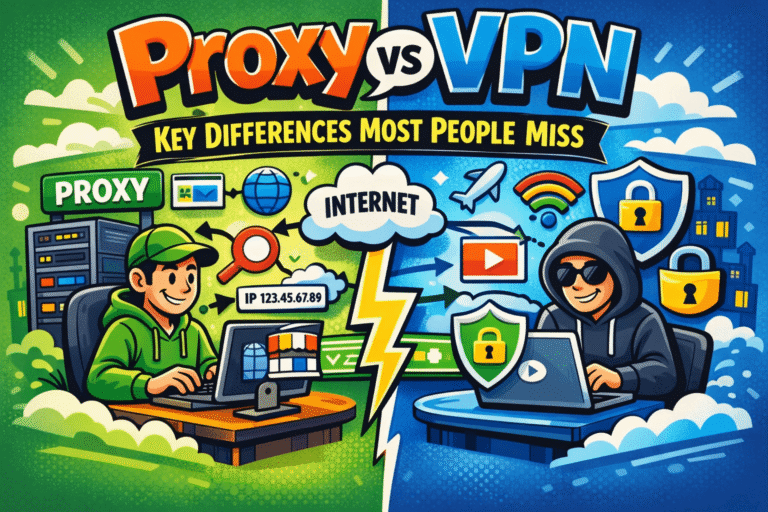
At a technical level, a proxy sits between your device and the destination server. Instead of connecting directly, your traffic is relayed through an intermediary IP address. To the website, the visible client becomes the proxy, not your original network.
This IP substitution is real and measurable. It is also the primary privacy benefit proxies provide.
Where expectations begin to diverge from reality is in how much information remains exposed beyond the IP layer. Websites do not rely on IP addresses alone. TLS fingerprints, HTTP headers, browser characteristics, and behavioral patterns often carry more identifying weight than the network address itself.
A proxy changes where traffic appears to come from, but it does not automatically change how that traffic behaves.
Residential vs Datacenter Proxies and Privacy Perception
Not all proxies are treated equally by websites, and this directly affects privacy outcomes.
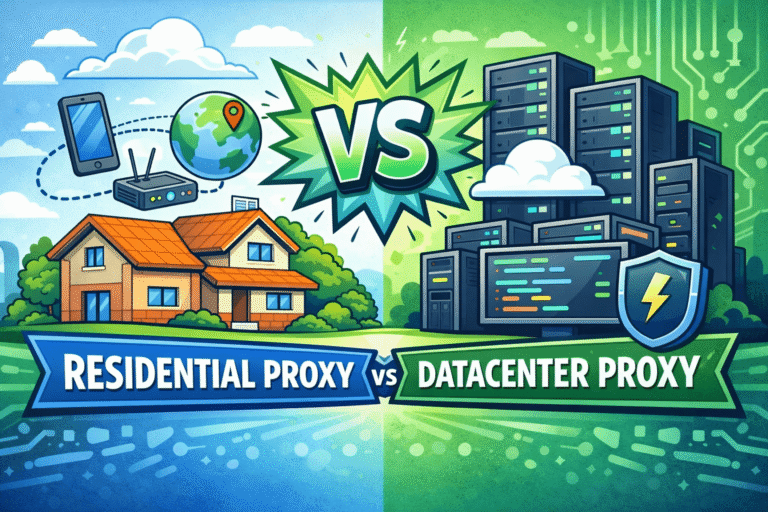
Datacenter proxies are typically hosted in cloud or colocation environments. They are fast, predictable, and easy to scale, but they are also well-mapped. Large platforms often classify these IP ranges as non-consumer infrastructure. From a privacy standpoint, this doesn’t mean they expose your real identity, but it does mean your traffic is more likely to be flagged, restricted, or logged differently.
Residential proxies, by contrast, use IP addresses assigned to consumer ISPs. Because these addresses resemble ordinary household connections, they tend to blend more naturally into typical traffic patterns. This reduces scrutiny and lowers the chance of immediate classification as proxy traffic.
The privacy implication here is subtle. Residential proxies don’t make you anonymous; they make you less distinct. That difference often determines whether a session is quietly accepted or actively inspected.
Detection Still Exists, Even with a Proxy
One of the most persistent misconceptions is that using a proxy automatically bypasses detection. In practice, proxies are one input among many.
Modern detection systems correlate IP reputation with request timing, protocol behavior, TLS signatures, and browser-level identifiers. If everything about a session looks automated or inconsistent with normal user behavior, the presence of a “clean” IP does not prevent scrutiny.
From a privacy perspective, this means proxies are most effective when they are part of a consistent and realistic traffic profile. When used in isolation, they may hide your IP but leave stronger identifiers untouched.
This is why proxies often improve privacy incrementally rather than absolutely.
Trust and the Proxy Operator Problem
Privacy discussions often focus on what websites can see, but the proxy operator itself is another critical factor.
When you route traffic through a proxy, you are transferring visibility from your ISP to the proxy provider. If the provider logs traffic, inspects payloads, or cooperates with third parties, the privacy gain may be limited or even reversed.
This is not a theoretical risk. Many low-cost or “free” proxy services monetize through logging, resale, or injection. Even reputable providers vary widely in logging policies, data retention, and operational transparency.
In practical terms, a proxy improves privacy against destination websites, but only if you trust the intermediary more than your original network. That trust decision is often overlooked.
Performance and Its Indirect Privacy Impact
Performance is not usually framed as a privacy issue, but it plays a role.
Slow or unstable proxies cause retries, timeouts, and abnormal request patterns. These behaviors stand out. They can increase logging, trigger rate limits, or draw attention to sessions that would otherwise remain unremarkable.
High-quality proxies with stable latency tend to produce traffic that looks ordinary. In that sense, performance indirectly supports privacy by reducing anomalies. Poor performance does the opposite, even if the IP itself is not blocked.
This is one reason why privacy outcomes often correlate with cost.
Cost, Scale, and Realistic Tradeoffs
Proxies that meaningfully improve privacy are rarely the cheapest option. Residential IPs, limited reuse, and low logging policies all increase operational costs. Datacenter proxies can still be useful, but they trade stealth for affordability and speed.
At small scale, this tradeoff may be acceptable. At larger scale, costs rise quickly, and privacy benefits plateau unless combined with careful session management and traffic design.
The key point is that proxies offer diminishing returns when treated as a standalone privacy tool. They are most effective when aligned with a specific threat model rather than used generically.
A Short, Practical Comparison
In simple terms, proxies help with exposure, not identity. They obscure your origin IP, but they do not erase fingerprints, behavior, or intent. Residential proxies reduce visibility by blending in; datacenter proxies reduce direct attribution but remain conspicuous. Trusted providers improve outcomes; unknown ones introduce new risks.
Understanding these differences prevents overreliance and misuse.
Verdict: What Proxies Can and Cannot Do for Privacy
Proxies can improve online privacy, but only within clear boundaries. They are effective at masking IP-based location and reducing direct linkage to your network. They are ineffective at preventing fingerprinting, behavioral correlation, or data leakage at higher layers.
Used thoughtfully, proxies are a practical privacy enhancement. Used carelessly, they become a cosmetic change that offers little real protection.
The most realistic expectation is this: a proxy is a tool, not a guarantee. It shifts who sees what, but it does not eliminate visibility. Privacy comes from understanding those shifts and designing around them, not from assuming the intermediary alone is enough.