Are Proxies Legal? What You Should Know Before Using Them
Proxies sit in a strange place in internet conversations. They’re widely used by developers, businesses, and security teams, yet they’re often mentioned in the same breath as fraud, abuse, or “shady activity.” That tension leads to a simple but important question: are proxies legal, and if so, where does the line actually sit?
The short answer is that proxies themselves are legal in most jurisdictions. The longer answer is more nuanced—and that nuance matters if you’re operating in the proxy or networking space, running automation, or selling proxy services. Legality depends far less on the technology and far more on how it’s used, where the IPs come from, and what rules you agree to when you access a website.
This article breaks the issue down clearly and practically, focusing on real-world behavior rather than myths or extremes.
Understanding What a Proxy Really Is
At a technical level, a proxy server is simply an intermediary. Your traffic doesn’t go directly from your device to a destination website; it passes through another server first, which then forwards the request on your behalf.
That design alone is not unusual or suspicious. Corporate networks, universities, CDNs, ISPs, and even browsers rely on proxy-like systems every day. Forward proxies, reverse proxies, load balancers, and gateways are all variations of the same core idea: controlled traffic routing.
Because of this, no modern legal system treats “using a proxy” as inherently unlawful. The law does not regulate proxies as a category of technology in the way it regulates weapons or restricted substances. Instead, legality emerges from context and intent.
Why Proxies Have a Reputation Problem
If proxies are neutral infrastructure, why do they attract so much legal anxiety?
The answer lies in association. Proxies are commonly used for:
- Web scraping at scale
- Bypassing geo-restrictions
- Avoiding IP-based rate limits
- Masking the origin of automated traffic
Some of those activities are legitimate. Others can cross legal or contractual boundaries. Over time, proxies have become linked—fairly or not—to the latter.
It’s important to separate three distinct layers that are often blurred together:
- The proxy technology
- The source and ownership of the IP addresses
- The activity performed through the proxy
Only the third layer typically triggers legal consequences.
Are Proxies Legal in General?
In most countries, including the United States, the European Union, the UK, and much of Asia, using a proxy is legal. There are no blanket laws banning proxy servers or proxy traffic.
Businesses use proxies for:
- Security isolation
- Monitoring uptime from multiple regions
- Testing localized content
- Protecting internal networks
Individuals use proxies for:
- Privacy protection on public networks
- Accessing region-specific content while traveling
- Avoiding tracking across sessions
None of these use cases raise legal red flags on their own.
Where problems arise is when proxies are used to violate other laws or binding agreements.
The Real Legal Fault Lines
Law vs. Terms of Service
One of the most misunderstood aspects of proxy legality is the difference between breaking the law and breaking a website’s terms of service.
Using a proxy to access a website that forbids automated traffic, scraping, or IP masking may violate that site’s terms. That is typically a civil issue, not a criminal one. The most common consequences are IP bans, account termination, or legal notices—not arrests.
However, repeated, large-scale violations combined with clear intent to bypass safeguards can escalate into legal disputes, especially when financial damage can be demonstrated.
Fraud, Abuse, and Misrepresentation
Proxies become legally problematic when they’re used as part of fraudulent activity. Examples include:
- Circumventing anti-fraud systems to perform chargebacks or account takeovers
- Impersonating users or businesses
- Evading law enforcement during criminal acts
In these cases, the proxy is incidental. The illegal activity would still be illegal without it. The proxy simply becomes part of the evidence chain.
Residential Proxies vs. Datacenter Proxies: Legal Implications
The legal conversation changes slightly depending on the type of proxy being used.
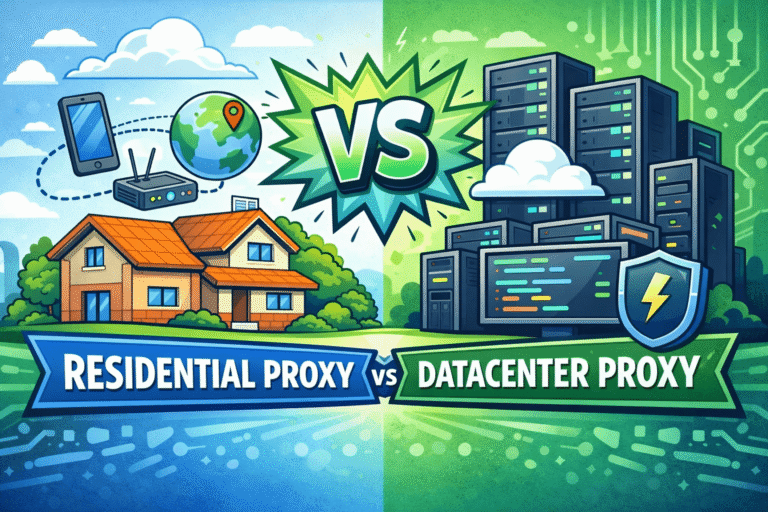
Datacenter proxies are typically owned or leased directly from hosting providers. Their IP ownership is clear, contractual relationships are explicit, and consent is not ambiguous. From a legal standpoint, these are straightforward.
Residential proxies are more sensitive. They route traffic through IPs assigned to consumer devices. This is not illegal by default, but it raises questions about consent and disclosure.
If residential IPs are obtained through clear opt-in programs—where users knowingly agree to share bandwidth in exchange for compensation or services—the model is generally considered legitimate. If IPs are harvested silently through malware, browser extensions without disclosure, or bundled software, that crosses into unlawful territory in many jurisdictions.
This distinction matters greatly for proxy providers and resellers. The legality of a residential proxy network depends less on geography and more on how transparently it was built.
Detection, Trust, and Legal Risk
Detection itself is not a legal issue. Websites are free to identify and block proxy traffic using technical signals such as IP reputation, ASN data, and behavioral analysis.
Problems arise when users actively attempt to circumvent protective measures designed to prevent abuse. Courts tend to look unfavorably on systematic evasion that causes measurable harm, especially when paired with deception or unauthorized access.
From a risk perspective, the most legally defensible proxy usage tends to share three traits:
- Clear, legitimate purpose
- Respect for access controls beyond simple IP blocks
- Avoidance of impersonation or misrepresentation
In other words, using a proxy does not grant immunity from accountability.
Cost, Scale, and Legal Exposure
Legal exposure often scales with activity. A single developer testing a site from another region is unlikely to attract attention. A large operation generating millions of requests per day through proxies is more likely to be scrutinized.
This is where cost and legality intersect. Cheaper proxy sources—especially residential ones with opaque origins—often carry higher legal and reputational risk. More expensive, enterprise-grade proxy services tend to invest heavily in compliance, documentation, and consent frameworks.
Cost alone doesn’t determine legality, but it often reflects how carefully a network is constructed.
A Short, Practical Comparison
At a high level:
- Proxies are legal infrastructure tools
- Using proxies to commit illegal acts is not legal
- Violating website terms is usually a civil matter, not a crime
- Residential proxy legality depends heavily on user consent
- Scale, intent, and transparency determine real-world risk
This is less about loopholes and more about responsibility.
Final Verdict: Are Proxies Legal?
Yes—proxies are legal in most parts of the world. They are a normal part of modern networking. But legality does not exist in a vacuum.
What matters is why you’re using them, how the IPs were obtained, and whether your activity respects legal boundaries beyond simple access rules. Proxies don’t absolve users from laws related to fraud, data protection, or unauthorized access. They simply change the path traffic takes.
For individuals and businesses operating in the proxy space, the safest position is not secrecy or clever evasion, but clarity. Understand the rules you’re operating under, choose proxy sources with transparent origins, and treat proxies as tools—not shields.
That mindset is what separates legitimate proxy usage from the kind that attracts legal trouble.