SOCKS5 vs HTTP Proxies: When Should You Use Each?
If you spend enough time working with proxies—whether for scraping, privacy, automation, or infrastructure—you eventually realize that not all proxies behave the same way. The difference between SOCKS5 and HTTP proxies is not just technical trivia. It directly affects reliability, detection rates, performance, and how much control you actually have over traffic.
This comparison matters because many people choose a proxy type based on habit or price, not on how the protocol behaves in real-world networks. That’s usually when things break: websites block sessions, apps fail silently, or traffic leaks in ways you didn’t expect.
This article breaks down SOCKS5 vs HTTP proxies from a practical, operator-level perspective—how they work, how websites see them, and when each one actually makes sense.
Understanding the Core Difference
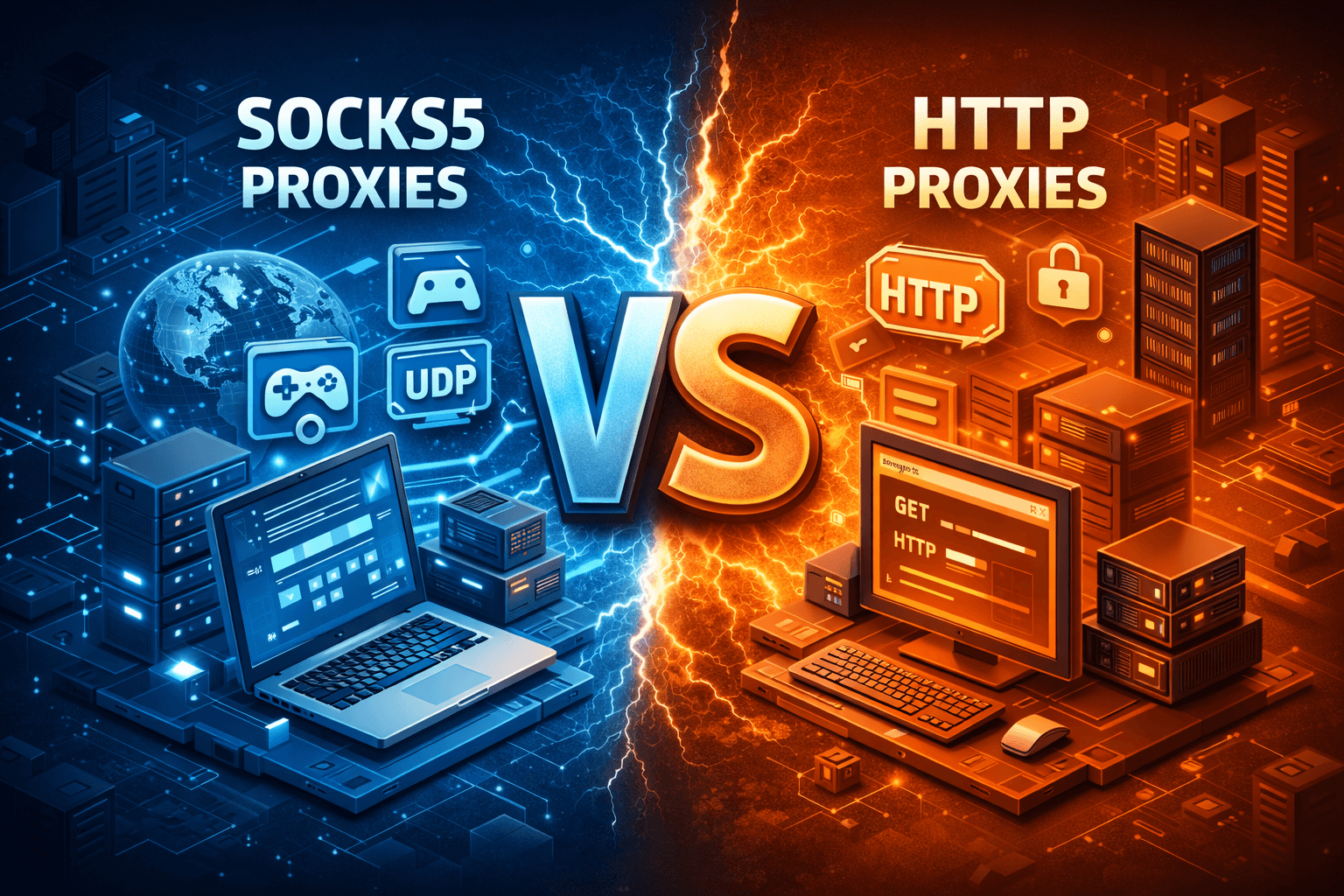
At a high level, HTTP and SOCKS5 proxies sit at different layers of the network stack.
An HTTP proxy understands web traffic. It knows what a request is, what headers are, and how responses are structured.
A SOCKS5 proxy does not care about protocols at all. It simply forwards raw network connections.
That single distinction explains most of the behavioral differences you see in practice.
How HTTP Proxies Really Work in Practice
HTTP proxies operate at the application layer. When your browser or script sends a request, the proxy terminates it, reads it, and then forwards a new request to the destination server.
This means the proxy can:
- Modify headers
- Inject or strip metadata
- Log requests at a granular level
- Apply rules based on URLs or domains
That visibility is both a strength and a weakness.
In controlled environments—corporate networks, caching systems, or simple web scraping—HTTP proxies are predictable and efficient. They are lightweight, easy to deploy, and widely supported by browsers and libraries.
But because HTTP proxies understand the request, they also leave a clearer fingerprint. Headers like Via, X-Forwarded-For, or subtle ordering differences often expose the proxy layer unless it is carefully configured.
Another practical limitation is protocol scope. HTTP proxies only handle:
- HTTP
- HTTPS (via CONNECT tunneling)
Anything outside that—DNS, QUIC, WebRTC, custom TCP services—either fails or bypasses the proxy entirely.
How SOCKS5 Proxies Behave at the Network Level
SOCKS5 proxies operate much lower in the stack. They do not parse HTTP headers or interpret requests. Instead, they forward TCP (and optionally UDP) connections byte-for-byte.
From the target server’s perspective, traffic coming through a SOCKS5 proxy looks far closer to a direct client connection. There is no HTTP-layer rewriting because the proxy never touches that layer.
This has several real-world implications:
First, application agnosticism. SOCKS5 works with browsers, scrapers, torrent clients, messaging apps, game launchers, and custom tools without special handling.
Second, protocol coverage. SOCKS5 supports:
- Raw TCP
- UDP (critical for DNS, QUIC, and some streaming protocols)
Third, lower detection surface. Because the proxy does not inject headers, detection relies mostly on IP reputation and behavioral signals rather than protocol artifacts.
The trade-off is control. SOCKS5 proxies cannot selectively rewrite requests or cache responses. What you send is what the server receives.
SOCKS5 vs HTTP Proxies in Real-World Detection
Detection is rarely about one signal. Websites combine IP reputation, request behavior, TLS fingerprints, header consistency, and session flow.
This is where the difference becomes practical.
With HTTP proxies, detection often happens early. Even well-configured setups can leak subtle inconsistencies:
- Header capitalization
- Proxy-specific header order
- Differences in CONNECT handling
- Proxy-aware TLS termination
On high-security checkout flows or login pages, these signals add up quickly.
With SOCKS5 proxies, detection shifts almost entirely to:
- IP history
- ASN reputation
- Traffic patterns
- Browser or client fingerprint
In other words, SOCKS5 does not make a bad IP good—but it avoids adding extra reasons to be flagged.
This is why SOCKS5 proxies are usually preferred for:
- Account management
- Checkout flows
- Login-heavy automation
- Applications that must behave like real user devices
Performance and Stability Considerations
Performance differences are often misunderstood.
HTTP proxies are slightly more efficient for pure web traffic because they operate at a higher level and can optimize requests. For simple scraping or API calls, they are fast and stable.
However, once traffic becomes complex—multiple connections, mixed protocols, or long-lived sessions—HTTP proxies can introduce friction:
- Connection resets during CONNECT tunnels
- SSL handshake inconsistencies
- Issues with HTTP/2 or newer protocols
SOCKS5 proxies shine in these scenarios. Because they forward raw connections, they handle long sessions and multiplexed traffic more naturally. Applications that open many parallel connections tend to be more stable over SOCKS5.
Latency differences are usually negligible and depend more on proxy quality than protocol choice.
Trust, Visibility, and Control
There is an often-overlooked trust dimension here.
With HTTP proxies, the provider can see full URLs, headers, and payloads unless you carefully encrypt and tunnel traffic. That may or may not matter depending on your threat model.
SOCKS5 proxies, while not inherently encrypted, expose far less structured information. They act more like a transport relay than a traffic interpreter.
From an operator’s perspective:
- HTTP proxies offer more control and visibility
- SOCKS5 proxies offer more neutrality and predictability
Neither is “more secure” by default. It depends on who runs the proxy and how it is deployed.
Cost and Availability in Practice
HTTP proxies are cheaper and more widely available, especially in datacenter networks. They are easy to scale and simple to resell.
SOCKS5 proxies, particularly residential or mobile ones, tend to cost more. This is not because the protocol is expensive, but because it is commonly paired with higher-quality IP sources.
In the market, SOCKS5 has become shorthand for “more flexible proxy,” even though the protocol itself does not guarantee quality.
A Short, Practical Comparison
In everyday use:
- HTTP proxies are efficient tools for web-only tasks where scale matters more than realism.
- SOCKS5 proxies are better suited for environments where traffic must look and behave like a real device.
The difference is less about speed and more about how much the proxy interferes with your traffic.
Verdict: Choosing Based on Behavior, Not Labels
The SOCKS5 vs HTTP proxies debate is not about which is better in absolute terms. It is about matching the proxy’s behavior to the job.
If you are running lightweight web scraping, API access, or controlled internal tooling, HTTP proxies are often sufficient and cost-effective.
If you are dealing with modern websites, strict detection systems, mixed protocols, or real-user simulation, SOCKS5 proxies are usually the safer choice—not because they are magical, but because they stay out of the way.
In proxy infrastructure, fewer assumptions and fewer modifications usually lead to fewer problems. Choosing the right protocol is one of the simplest ways to achieve that.